How to Price 3D Printed Models You Sell Online

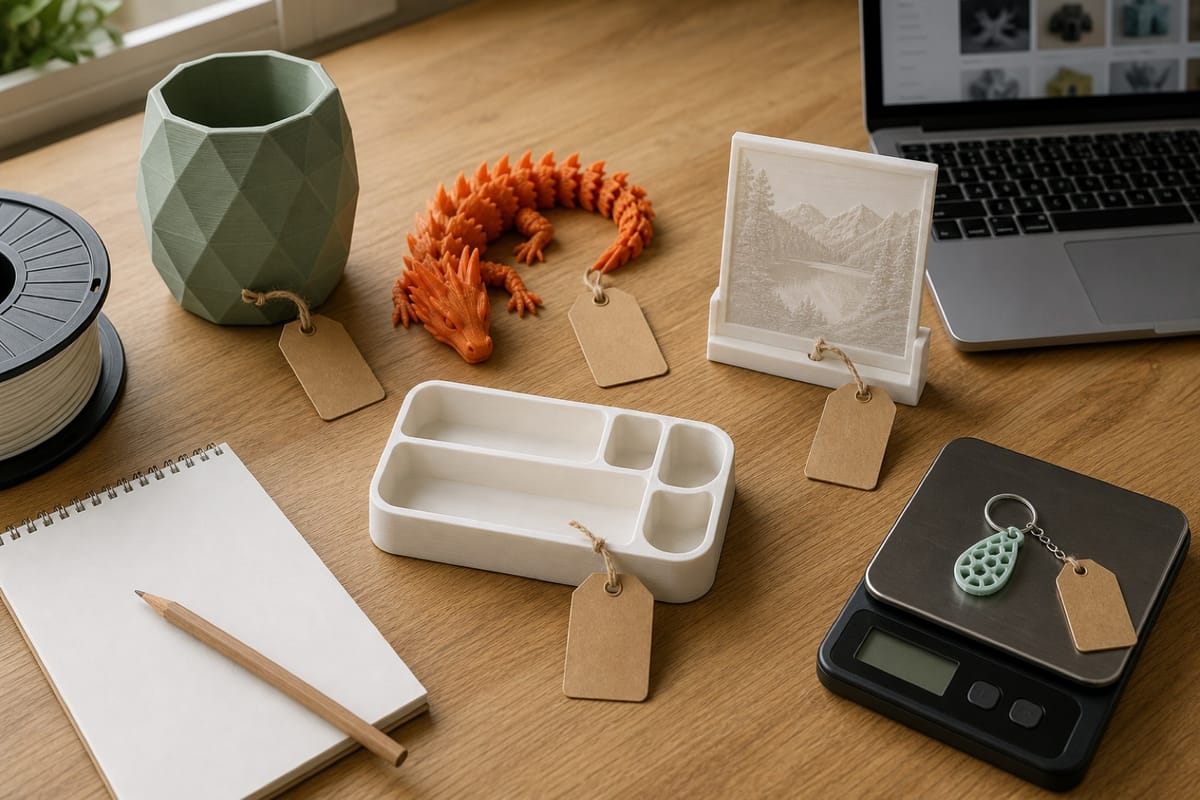
Almost every new 3D print seller prices the same way: check how much filament the slicer used, multiply by the spool price, double it, round to something that ends in 9. Then they wonder why a shop doing 40 orders a month somehow isn't making money.
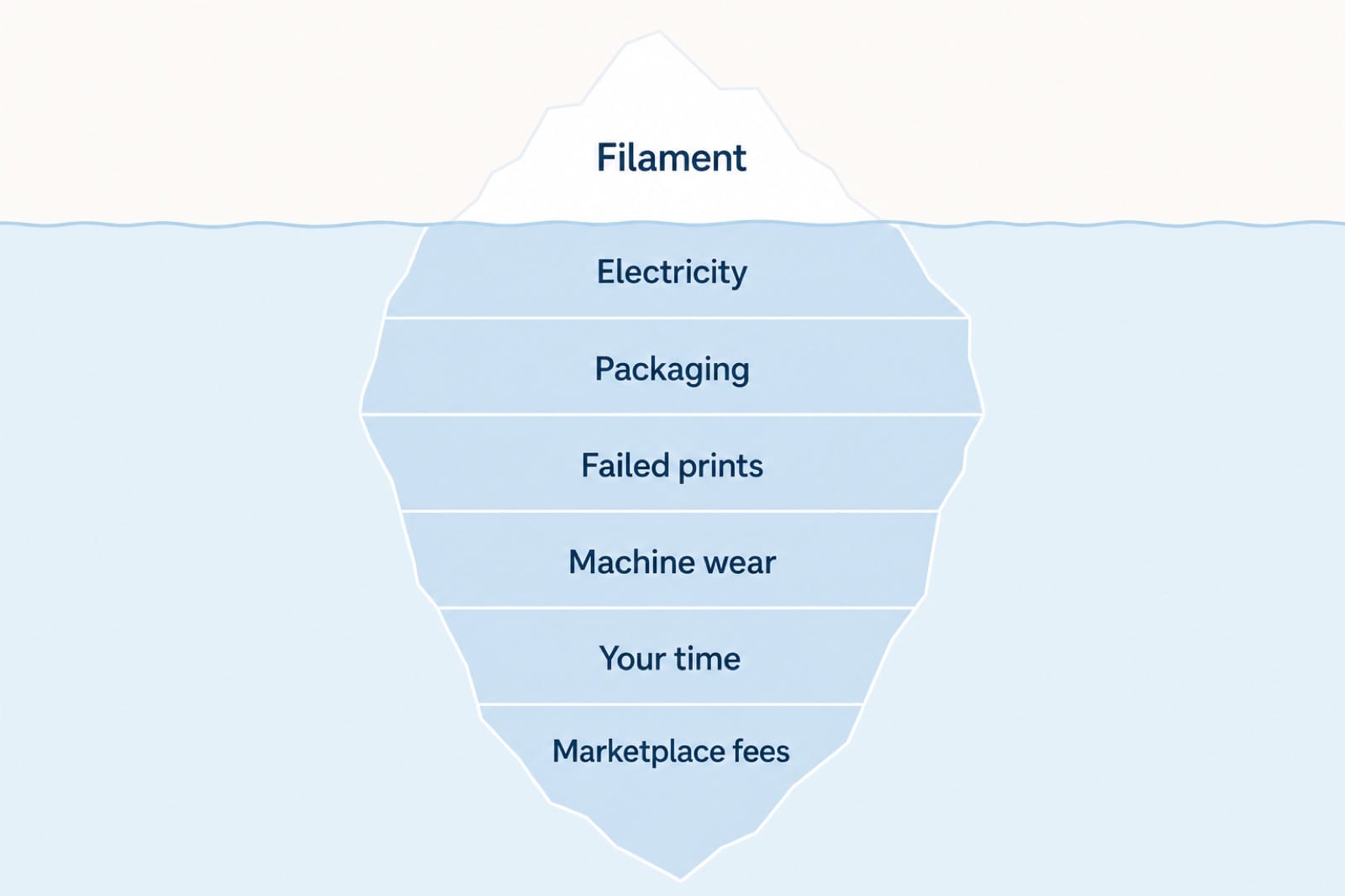
The problem isn't the doubling. It's that filament is usually under 15% of what a sale actually costs you. Price off that one number and you're not marking up your costs — you're marking up a rounding error.
This is the short version of how to price 3D printed products properly: what really goes into a unit, a formula that works, and the one metric that should decide what you print at all.
What a sale actually costs you
Filament is the visible tip. Here's everything under the waterline.
| Cost | Typical range | How to get your number |
|---|---|---|
| Filament / resin | $0.30–$3.00 | Slicer gram estimate × (spool price ÷ 1000) |
| Electricity | $0.02–$0.15 | Most FDM printers pull 50–150 W; at $0.12/kWh a 2-hour print is pennies |
| Machine wear | $0.05–$0.30 | Printer cost ÷ realistic lifetime hours (3,000–10,000), × print hours |
| Failure allowance | 5–10% of production cost | You will scrap prints. Budget for it instead of being surprised. |
| Packaging | $0.30–$1.00 | Mailer, label, tissue, thank-you card |
| Your labor | $0.50–$3.00 | Support removal, sanding, assembly, packing — at a real hourly rate |
| Actual postage | $3.00–$6.00 | What the carrier charges, not what you charged the buyer |
| Marketplace fees | ~11% + $0.45 | On Etsy: 6.5% transaction, 3% + $0.25 processing, $0.20 listing |
Two of these get skipped constantly. Failed prints feel like bad luck rather than a cost, so people leave them out — but a 7% scrap rate is a permanent 7% tax on every product you make. And your labor gets skipped because it doesn't leave your bank account. If you never price it in, you've built yourself a job that pays nothing and calls it profit.
The pricing formula
Because marketplace fees are a percentage of what you charge, you can't just add a margin on top of cost. Raising the price raises the fee. You have to divide instead:
Price = (Total unit cost + $0.45) ÷ (1 − fee rate − target margin)
On Etsy, fee rate is about 0.11 and the $0.45 covers the fixed listing and processing charges. So for a product with $5.85 in real costs and a 60% target margin:
($5.85 + $0.45) ÷ (1 − 0.11 − 0.60) = $6.30 ÷ 0.29 = $21.72
That's your floor, not your final answer. Round it to a real-world price point ($22.99, or $24.99 with free shipping) and check it against what similar products actually sell for.
Target margins by product type:
| Product type | Target net margin |
|---|---|
| Generic prints (models anyone can download) | 40–50% |
| Original designs | 50–60% |
| Personalized / made-to-order | 60–70% |
Personalization is the single biggest lever here. A named, customized version of a product carries a 20–50% premium over the identical generic one and — more importantly — it can't be undercut, because nobody else has the same listing.
Run your real numbers
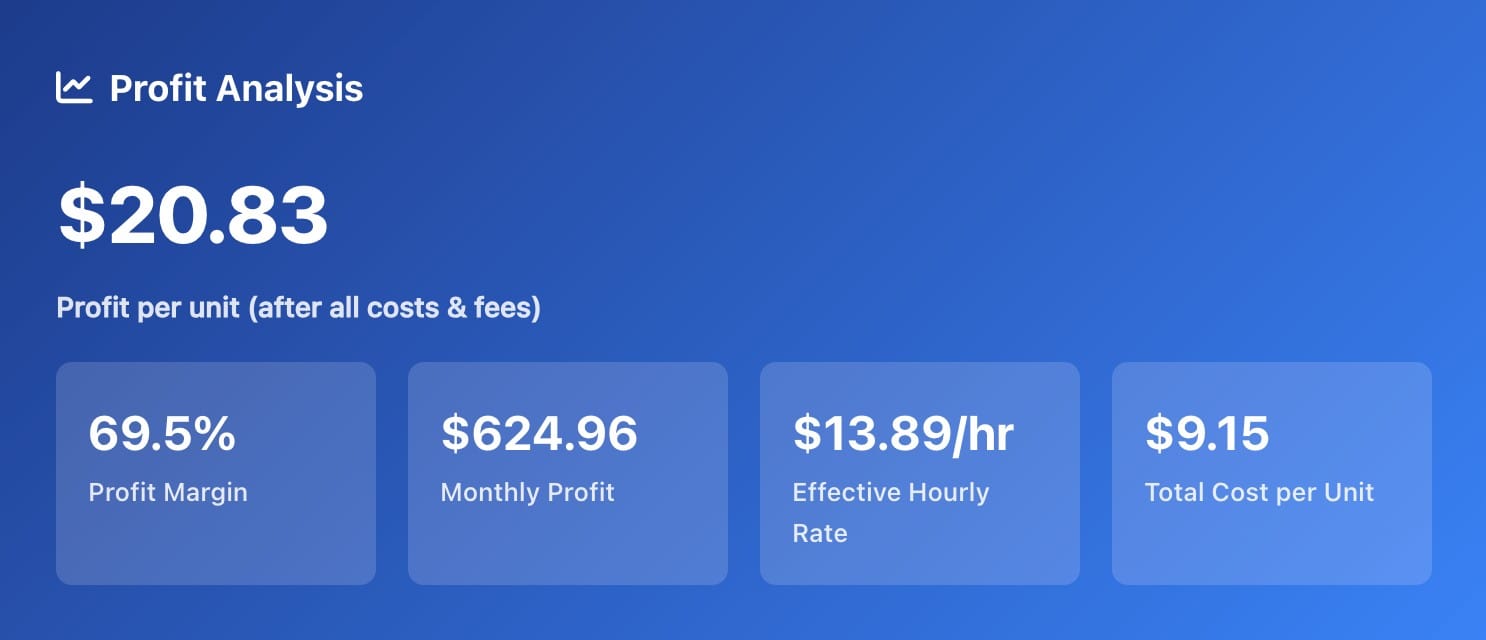
Doing that division by hand for every product gets old fast, and it's easy to forget the shipping transaction fee. The Etsy Profit Calculator does the whole thing live in the browser: enter your sale price, per-unit costs, print time, and what you charge for shipping, and it calculates every Etsy fee and shows profit per unit, margin, monthly profit, and effective hourly rate as you type.
Here's what its default scenario looks like — a $24.99 item with $4.99 shipping, $1.50 of filament, $0.10 of electricity, $0.75 of packaging, a 90-minute print, and $3.50 of actual postage:
| Revenue collected | $29.98 |
| Etsy fees | $3.30 |
| Production + shipping | $5.85 |
| Profit per unit | $20.83 |
| Profit margin | 69.5% |
| At 30 sales/month | $624.96 |
| Effective rate | $13.89 per printer-hour |
One honest caveat about those defaults: there's no machine wear, no failure allowance, and no labor in them. That's what the Other Costs per Unit field is for. Put a realistic number there — even $0.90 — and watch the margin move. A pricing tool that flatters you isn't doing its job.
The number that should decide what you sell
Margin percentage tells you whether a product is healthy. Profit per printer-hour tells you whether it's worth printing.
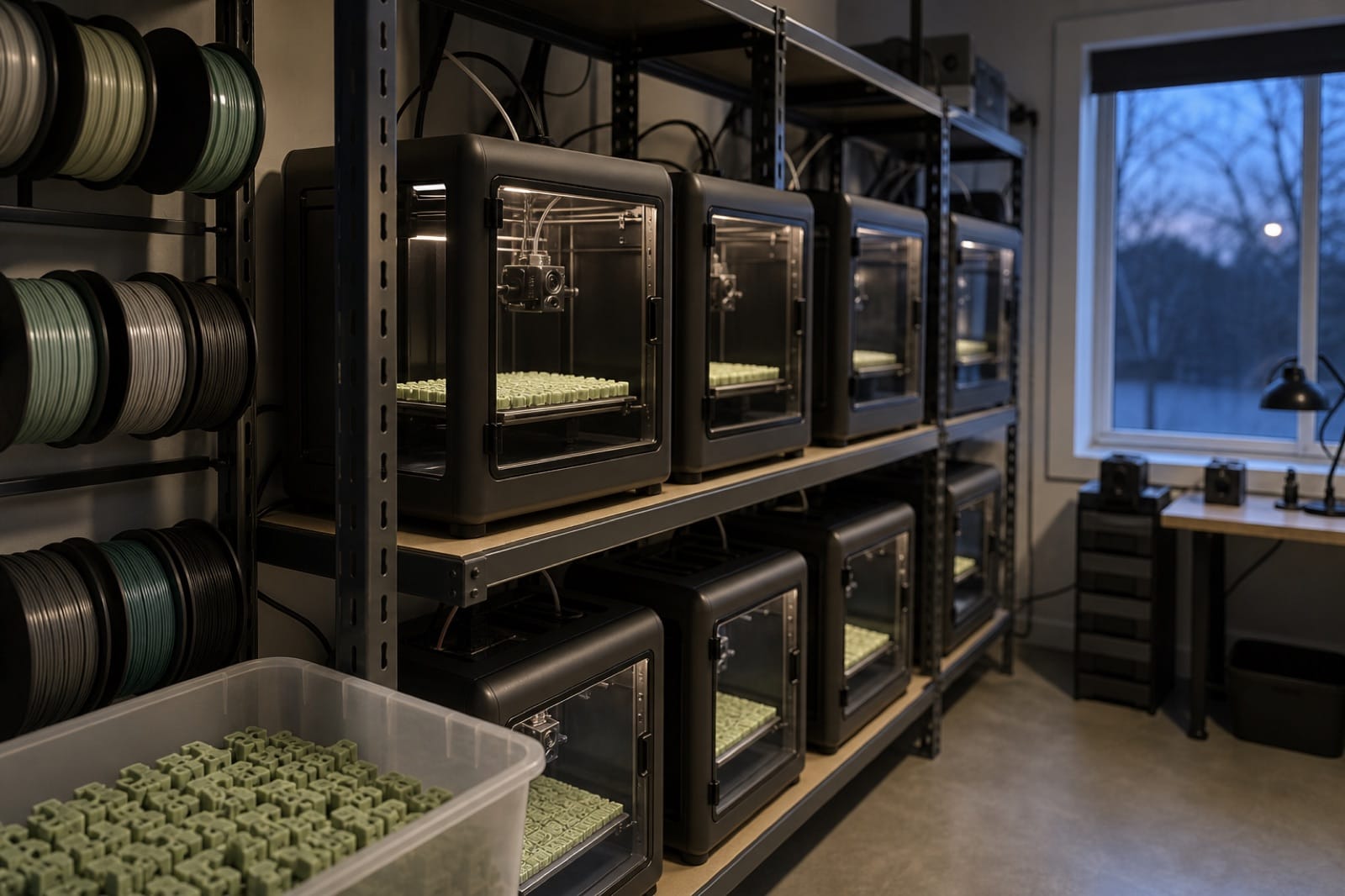
Your printer is the bottleneck in this business, not your bank account. So compare products by what they earn per hour of machine time:
- The $24.99 item above: $20.83 profit over a 90-minute print = $13.89/hour
- A $9.99 keychain: $6.00 profit over a 25-minute print = $14.40/hour
The keychain has less than a third of the sale price and it's the better use of your printer. This is why print-farm sellers gravitate toward small, fast, high-personalization items — and why that gorgeous 14-hour articulated dragon selling for $45 is often a worse business than a tray of $12 nameplates.
Two things move this number more than pricing does:
Batch the plate. Print time doesn't scale linearly with quantity — you pay the heat-up, homing, and first-layer overhead once whether you print one part or twenty. Filling the build plate can cut your per-unit machine time meaningfully, and it collapses your handling time even further.
Design for less post-processing. Every minute of support removal and sanding is unpaid labor. Orienting a part so it prints support-free is worth more per unit than shopping around for cheaper filament.
Should you offer free shipping?
Usually yes — but understand what you're doing. "Free shipping" means you're paying the postage and burying it in the sale price, and Etsy charges its 6.5% transaction fee on the total either way. The math barely changes.
What does change is visibility: Etsy's search algorithm favors free-shipping listings, and shipping charges revealed at checkout are a well-known cause of abandoned carts. So take your average postage, add it to the item price, and turn shipping off. A $20 item with $4 shipping becomes a $24 item with free shipping, ranks better, and converts better.
Five mistakes that quietly kill margins
- Pricing against the cheapest seller. There's always someone selling below cost until they quit. Competing with them just means quitting alongside them.
- Forgetting the shipping fee. Etsy takes 6.5% of the shipping you charge, on top of everything else.
- Never raising prices. Most shops are underpriced. Raise one listing 15% and watch what actually happens to sales — usually less than you fear.
- Ignoring offsite ads. Once you cross $10K in annual sales, Etsy's 15% offsite ads fee becomes mandatory on those orders. Price with headroom for it.
- Treating labor as free. If your effective hourly rate is below what you'd earn doing anything else, it's a hobby with extra bookkeeping.
Quick reference: what 3D prints sell for
Use these as sanity checks, not targets. Your costs decide your floor; the market decides your ceiling.
| Category | Typical price |
|---|---|
| Keychains, ornaments, small trinkets | $8–$15 |
| Cookie cutters | $5–$15 |
| Flexi / articulated toys | $12–$25 |
| Desk organizers, planters | $15–$30 |
| Custom nameplates, signs | $15–$35 |
| Lithophanes | $15–$40 |
| Large vases, lamps, display pieces | $25–$60 |
| Anything personalized | +20–50% over the generic version |
The short version
Add up every real cost — materials, power, machine wear, scrap, packaging, postage, and your time. Divide by 1 − fee rate − target margin to get your floor price. Check it against the market, round it to a clean number, fold shipping in, and then rank your products by profit per printer-hour rather than by price.
Run your own numbers in the Etsy Profit Calculator — it's free, needs no signup, and takes about ninety seconds per product. If you want to tighten up the cost side first, the 3D Print Cost Calculator and Print Time Estimator will get you accurate inputs to feed it.
FAQ
How much should I charge for 3D printing per hour? Rather than quoting an hourly rate, price the product: total your real per-unit costs and divide by 1 − fee rate − target margin. Then check the result as profit per printer-hour to see whether that product deserves the machine time.
What profit margin should I aim for on 3D prints? 50% net or better after all costs and fees. Personalized and made-to-order items regularly reach 60–70%. Below 40%, you're almost certainly underpriced.
Do I need to include my printer's cost in pricing? Yes. Divide the purchase price by a realistic lifetime of 3,000–10,000 print hours and charge that per hour of printing. It's small per unit, but it's what funds your next printer.
Why is my margin high but my income low? You're probably selling slow-printing products. A 70% margin on a 10-hour print earns less per week than a 55% margin on a 30-minute one. Compare products by profit per printer-hour.